Presence Isn't Charisma: A Leader's Guide to Pressure
Presence isn't charisma. It's what you do with the thirty seconds before you react.
Pressure doesn't build character. It reveals whatever was already there.
Most leaders think a high-stakes moment is a test of composure. Either you have it or you don't. I don't teach it that way. Composure is a sequence, not a personality trait, and it can be interrupted, redirected, and rebuilt in real time, in under a minute.
You don't need to become a calmer person. You need a way to catch the moment before your old pattern takes over.
Why Pressure Reveals Leadership, Not Just Tests It
Change exposes patterns that were always running quietly underneath. A merger, a new team, a promotion into unfamiliar territory. None of it creates your reactions from scratch. It just turns the volume up on habits you've had for years: the impatience with people who decide differently than you do, the instinct to solve a problem instead of coaching someone through it, the tendency to over-explain when you don't feel trusted yet.
None of that is a character flaw. It's information. The goal isn't to eliminate the pattern. It's to notice it fast enough to choose something else before it runs the whole interaction for you.
The State → Story → Strategy Loop
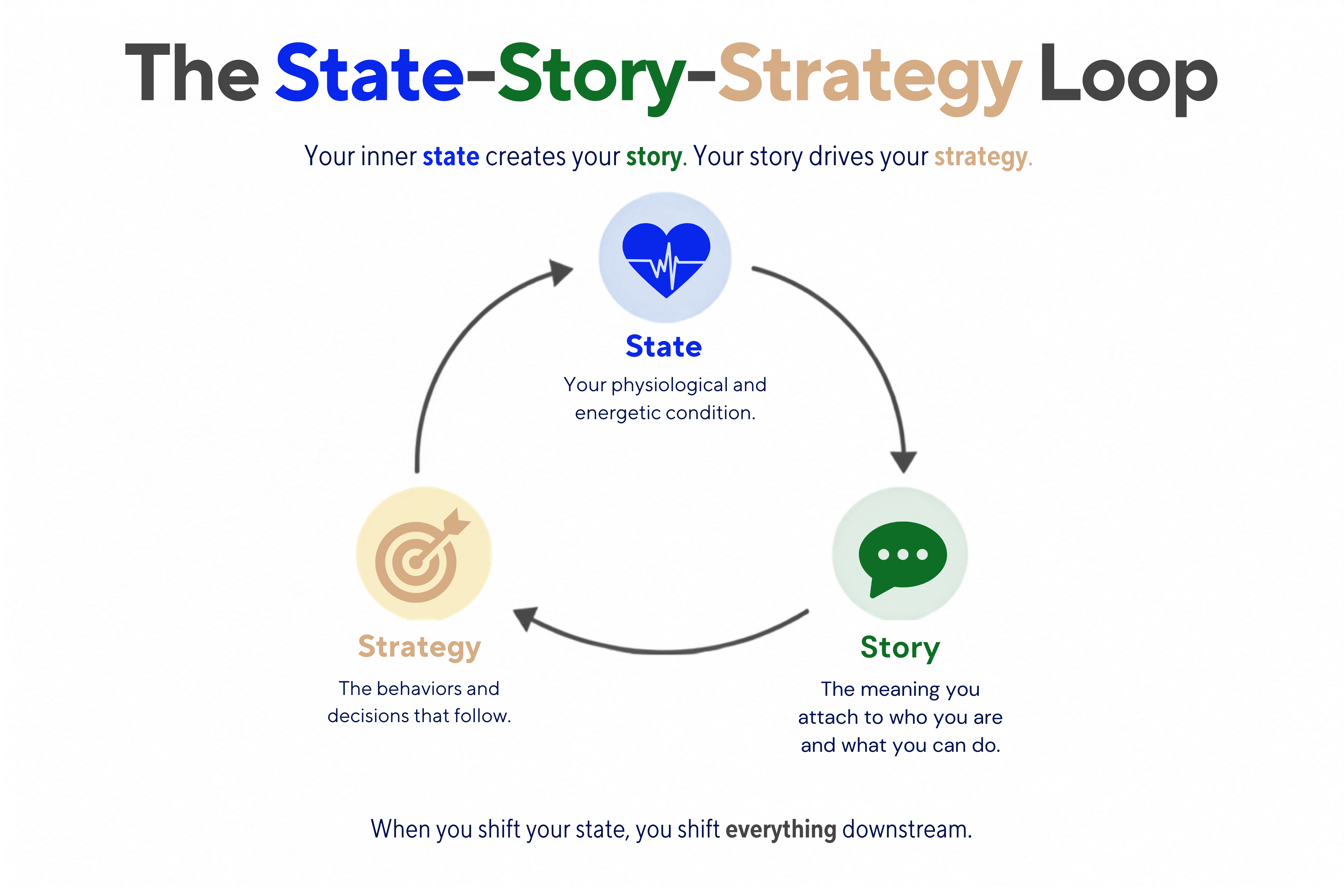
Here's the model I keep coming back to, because it applies everywhere and it's fast enough to use mid-conversation.
Your internal state, energetic, physical, emotional, shapes the story you tell yourself about what's happening. That story shapes your strategy, the actual decision or action you take. And your strategy loops back and reinforces your state. It doesn't matter where you enter the loop. Any point can shift the other two.
Most people try to fix the strategy first. Force a better decision while the state underneath it is still off. That rarely works. If you're depleted, dehydrated, or physically wound up, no amount of willpower produces a clear decision. Sometimes the fastest fix isn't a better plan. It's standing up and going for a walk.
The Logic Chain: Finding Your Entry Point
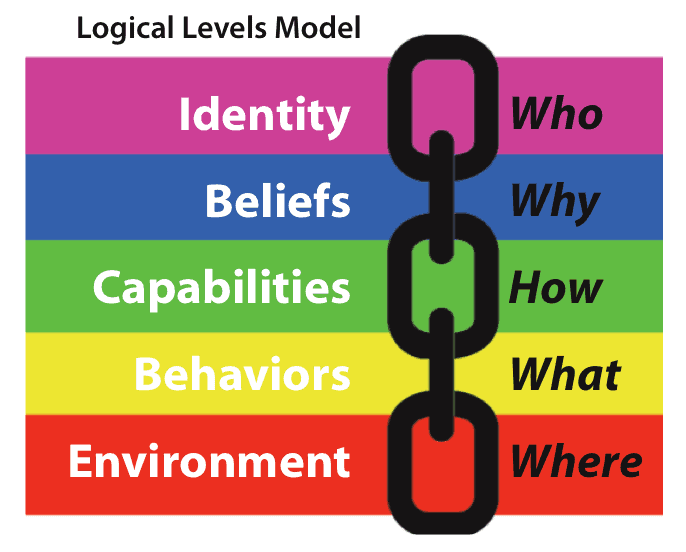
The loop tells you something's off. The logic chain tells you where to go fix it. Think of it as five linked points: environment, behavior, beliefs, capability, identity.
Some people need to change their environment before anything else moves. A messy office, a chaotic calendar, a room that doesn't match the outcome they're trying to create. Others need a belief shift, or a skill they don't have yet, before the rest can follow. The chain isn't a hierarchy. It's a map of possible entry points, and your job is to find the one that's easiest to access right now, not the one that looks most impressive.
Borrow the Avatar When Your Own Energy Isn't There
Early in my career, walking into big rooms to speak, I didn't always feel the confidence the moment required. What worked wasn't forcing it. It was asking myself: how would the most grounded version of someone I admire walk into this room right now? Then stepping into that energy on purpose, before I needed it, not in the middle of needing it.
This isn't about pretending. It's a bridge. You use it until you can access that same steadiness without borrowing it, and most people can, with enough repetition. But on the days your own switch doesn't flip fast enough, borrowing someone else's energy on purpose beats waiting to feel ready.
The Preparation Framework
Before any high-stakes moment, a hard conversation, a meeting where the room doesn't fully trust you yet, ask yourself four questions. What's my intention here? What outcome do I actually want? How do I want to be experienced? And on a scale of one to ten, what's my actual responsibility in this: is this mine to solve, mine to coach, or not mine at all?
That last question does the most work. Leaders who step in and solve everything themselves because it's faster aren't being helpful. They're removing the chance for someone else to build the skill, and quietly making themselves the bottleneck. Ask whether the person in front of you has the skill and the will to handle it themselves before you take it from them.
Trust Is Built, Borrowed, or Both
New teams don't hand out trust for free, and that's not a problem to fix. It's a starting condition to work with. Trust comes from two places. Internal trust, built the slow way, through track record and time. And borrowed trust, where someone else's credibility opens a door for you faster than you could open it alone: a warm introduction, a leader who vouches for you before the room knows you.
If you manage people who manage other people, this compounds. You're not just building trust for yourself. You're becoming the borrowed authority that lets the leaders under you build trust faster with their own teams.
Your Executive Presence Audit
Run this against yourself honestly, without turning it into self-criticism. Am I over-explaining? Rushing decisions, or sitting on ones I should have made already? Seeking reassurance externally instead of trusting my own read? Taking on responsibility that belongs to someone else? Stepping in to solve instead of coaching someone through it?
None of these are right-or-wrong question. The only real barometer is whether you're getting the outcome you actually want. If you're not, that's not proof you failed. It's just your signal for where to enter the chain.
Where to Start This Week
Pick one high-pressure moment coming up in the next few days. Before it happens, run the Preparation Framework: intention, outcome, how you want to show up, and your actual responsibility on a scale of one to ten. Then notice, during the moment itself, whether your state, your story, or your strategy is the one that's off. You don't have to fix all three. You just have to find the one you can access right now.
If you're leading a team through real change right now and recognize any of this, let's talk. I work with a small number of leaders at a time on exactly this kind of work.
Related reading: Future Self — Vision Casting for 2026


